
Free Shipping in the USA on nearly all items!
Limited phone hours during the Holidays! Call us: 888-611-9305
Free Shipping in the USA on nearly ALL items! Limited phone hours during the Holidays!

For a 2x4 tent, target 300 to 600 µmol/m²/s during vegetative growth and 700 to 1000 µmol/m²/s in flower, measured at canopy height across multiple points, not just the center. Size your fixture by efficacy (µmol/J, or PPE) and its PPFD map, not by watts. Going past roughly 1,000 µmol/m²/s without added CO₂ tends to waste electricity rather than add yield.
TL;DR:
- A full spectrum quantum sensor at canopy height should capture nine points across the tent; average them before calculating DLI from hours of light.
- Edge readings may run 30% to 40% below the center, so a central reading can overstate exposure and leave corner plants underlit.
- Fixture maps measured at 18 inches will not predict the same canopy readings at 24 inches, so match test height to your setup.
- At peak flower, 900 µmol/m²/s for 12 hours delivers about 38.9 moles per square meter per day, a useful benchmark for checking canopy exposure.
- When the current fixture cannot meet its target, extending the photoperiod by an hour or two can raise DLI without buying new equipment.
PPFD tells you light intensity at one moment. Daily Light Integral (DLI) tells you how much usable light your canopy receives over a full photoperiod, and it’s the number that actually correlates with growth and yield. Once you know your target DLI, you can trade PPFD against hours of light to hit it.
PPFD and photoperiod are interchangeable up to a point: the same DLI comes from either higher intensity over fewer hours or lower intensity over more hours, using DLI = PPFD × photoperiod. Medium-light crops fall in the 6 to 12 mol·m⁻²·d⁻¹ band, high-light crops in 12 to 18, and very high light crops above 18, which is where mature cannabis flower typically sits. Pushing intensity above roughly 1,000 µmol/m²/s generally requires CO₂ enrichment to convert that extra light into real growth instead of stress.
A single center reading tells you almost nothing about what your plants actually receive. Here’s a repeatable protocol:
Worked example: an average canopy PPFD of 800 µmol/m²/s at a 12-hour photoperiod gives 800 × 12 × 3600 ÷ 1,000,000, or about 34.6 mol·m⁻²·d⁻¹.
Edge readings can run 30 to 40% lower than center readings on many fixtures, which is why relying on a single point or on manufacturer peak specs skews your DLI math and leaves corner plants underlit. The most common mistakes are measuring only at the center, ignoring tent-wall reflectivity, and taking readings at the wrong height as plants grow taller.

Photosynthetic Photon Efficacy (PPE), measured in µmol/J, tells you how many usable photons a fixture produces per watt of electricity. Two fixtures that draw the same wattage can output very different numbers of usable photons, so watt draw by itself tells you almost nothing about canopy intensity.
A PPFD map, usually included on a fixture’s spec sheet, shows measured intensity across a grid at a given hanging height. Match that grid’s footprint to your 2x4 tent dimensions rather than assuming a fixture rated for “4x4 coverage” will deliver even light in a narrower space.
Pro Tip: Check the hanging height listed with a fixture’s PPFD map. A fixture tested at 18 inches will read very differently at 24 inches, and that gap matters more in a tight 2x4 footprint than in a larger room.
For more on why watt-per-square-foot calculations fall short, see our notes on sizing by watts per square foot.
Raising a fixture spreads light over a wider area but lowers peak intensity and softens hot spots in the center. Most quantum board fixtures for a 2x4 tent perform best hung 12 to 24 inches above canopy, adjusted upward as plants stretch and downward once flower sites fill in.
Reflective tent walls also reduce edge loss meaningfully, so a tent with a true Mylar interior does measurable work alongside fixture placement. For hanging-height examples at different wattages, our guide to LED hanging distance walks through sample distance tables.
These five recipes cover a full cycle in a 2x4 tent, with DLI calculated from DLI = PPFD × hours × 3600 ÷ 1,000,000:
When you can’t reach these PPFD numbers with your current fixture, extending the photoperiod by an hour or two raises DLI without buying new equipment. Growers running lower-PPE lights often get better results staggering canopy height through training than by cranking a fixture past its efficient range.
Most of the PPFD loss we see in grower photos comes from the same cause: light that never reaches lower leaves and inner bud sites because it’s all aimed from directly overhead. Our proximity systems address this by placing supplemental light close to the canopy itself, on the proprietary premise that intra-canopy photons raise usable PPFD where top lighting alone cannot reach.
For more on measuring and improving uniformity, see our breakdown of under-canopy placement and measurement or browse our under canopy grow lights collection directly.
Chasing the highest PPFD number on a spec sheet is the wrong goal. A fixture with strong PPE and an even map at 800 µmol/m²/s will outgrow a cheaper board claiming 1,000 µmol/m²/s with a terrible edge falloff. As PPFD climbs, your exhaust fan and temperature control need to climb with it, and CO₂ enrichment only makes sense once you’re running commercial-grade intensity with the ventilation to match. For most 2x4 setups, one well-reviewed fixture rated for that footprint, or two smaller boards spaced for even coverage, gives the best mix of uniformity and efficiency without overcomplicating the grow.
— Scott
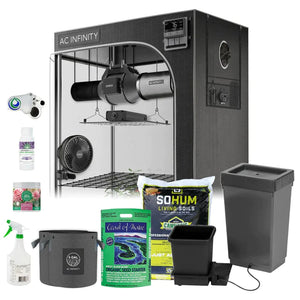
Hitting the ranges above starts with a tent and fixture pairing sized correctly for a 2x4 footprint instead of stretched from a larger kit. We carry tent options built for this exact space, along with top lighting and under-canopy fixtures sized to match the PPFD maps discussed throughout this guide.

Check specs and PPFD maps on any of these pages, or visit our full catalog to compare tents, lighting, and environmental controls side by side.
Most growers fit four to six plants in a 2x4 tent using Sea of Green training, or two to four larger plants under techniques like Screen of Green that spread fewer plants across the full canopy. The right number depends more on your training method and canopy PPFD uniformity than on tent size alone.
A 4x8 tent needs roughly four times the fixture coverage of a 2x4 space, since it has four times the canopy area. PPFD targets apply in flower, but you’ll need multiple fixtures positioned and spaced to maintain even coverage across the larger footprint rather than one oversized unit.
A 4x4 tent generally gives six plants enough room to develop a full canopy without excessive crowding, though a 2x4 tent can work for six smaller plants grown close together with heavy training. Spacing depends on your training style and how long you intend to veg before flipping to flower.
A 4x4 tent typically holds four to nine plants depending on training method, with Sea of Green setups on the higher end and larger, less-trained plants on the lower end. Canopy density should match your fixture’s PPFD map so that plants near the edges still receive adequate intensity.
0 of 3 items selected


Leave a comment