
Free Shipping in the USA on nearly all items!
Limited phone hours during the Holidays! Call us: 888-611-9305
Free Shipping in the USA on nearly ALL items! Limited phone hours during the Holidays!

A shelf grow light is a specialized LED fixture mounted directly above plants on indoor shelving to deliver the light intensity, spectrum, and photoperiod that natural window light cannot reliably provide in urban apartments. For any shelf grow light urban garden setup to produce real food rather than decorative greenery, the industry standard is 30–40 watts per square foot of growing area. Anything below that threshold supports aesthetics, not biomass. Ledgrowlightsdepot builds LED systems specifically around this standard, and their proximity-focused designs address the single biggest failure point in shelf gardening: light that looks bright but never reaches the canopy with enough intensity to matter.
Wattage is the first number every urban gardener should nail down before buying anything else. Experts recommend 30–40 watts per square foot for productive plant growth on shelves. A standard 2-foot by 4-foot shelf tier covers 8 square feet, which means you need 240–320 watts of actual LED draw, not the inflated “equivalent” wattage printed on budget packaging.
Dimmability matters just as much as peak wattage. Modern LED grow lights for shelves offer brightness levels from 20% to 100% with timer presets at 8, 12, or 16 hours. Seedlings thrive at lower intensity and shorter photoperiods. Mature herbs and leafy greens need full power and longer daily cycles.
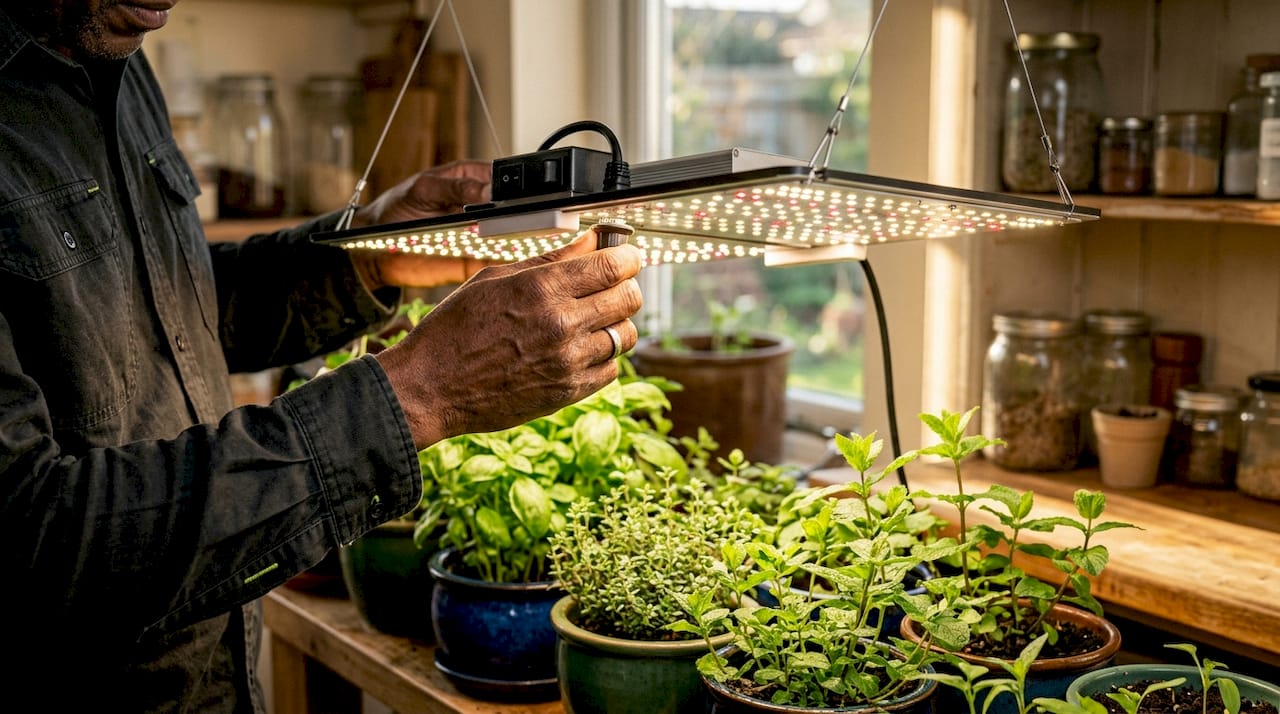
Pro Tip: Set new seedlings at 20–30% brightness for the first two weeks, then step up intensity by 10% every few days. This prevents light stress and builds stronger root systems before you push for maximum growth.
Automated timers remove the single most common beginner mistake: inconsistent photoperiods. A grow light schedule that runs at the same time every day outperforms manual switching every time. Plants respond to light cycles the way humans respond to sleep schedules. Disruption slows growth even when all other conditions are correct.
Mounting height is where most urban gardeners lose yield without realizing it. Light intensity drops sharply with distance from the source due to photon flux density drop-off. A light that delivers 400 micromoles at 4 inches may deliver less than half that at 12 inches.
The correct distances depend on plant type:
Tiered shelving creates a vertical spacing challenge because each tier has a fixed ceiling. The table below shows how to match shelf height to plant category.
| Shelf tier height | Best plant category | Recommended light distance |
|---|---|---|
| 12 inches | Microgreens, seedlings | 10–12 inches |
| 16 inches | Leafy greens | 8–10 inches |
| 20 inches | Herbs | 6–8 inches |
| 24 inches or more | Compact fruiting plants | 6–8 inches |
Adjustable-height light bars solve the fixed-ceiling problem on most wire rack shelving. Look for fixtures with hanging cables or ratchet straps that let you raise or lower the light as plants grow. Vertical garden lighting that cannot be repositioned forces you to choose between burning young plants and starving mature ones.
Spectrum is the quality side of grow lighting, and it is just as important as quantity. Plants use blue light (roughly 400–500 nanometers) for compact vegetative growth and red light (roughly 600–700 nanometers) to trigger flowering and fruiting. Full spectrum LEDs cover both ranges and mimic the broad output of natural sunlight.
Gardening expert Stephanie Rose stresses that intensity matters more than labels. A light marketed as “full spectrum” still fails if it cannot deliver adequate photon flux at canopy level. The color of the light is secondary to whether enough photons are actually hitting the leaf surface.
Here is what spectrum selection looks like in practice:
Pro Tip: Do not judge a grow light by how it looks to your eye. The pink or purple glow of red-blue LED arrays can look dim but deliver strong photosynthetically active radiation. Use a PAR meter or a phone-based light meter app to measure actual output at canopy level.
LED technology effectiveness for shelf gardens has improved significantly. Modern full spectrum LEDs now cover the complete photosynthetically active radiation range without the heat output that older HID and fluorescent fixtures produced. That lower heat output is critical on shelves where fixtures sit just inches from plant tissue.
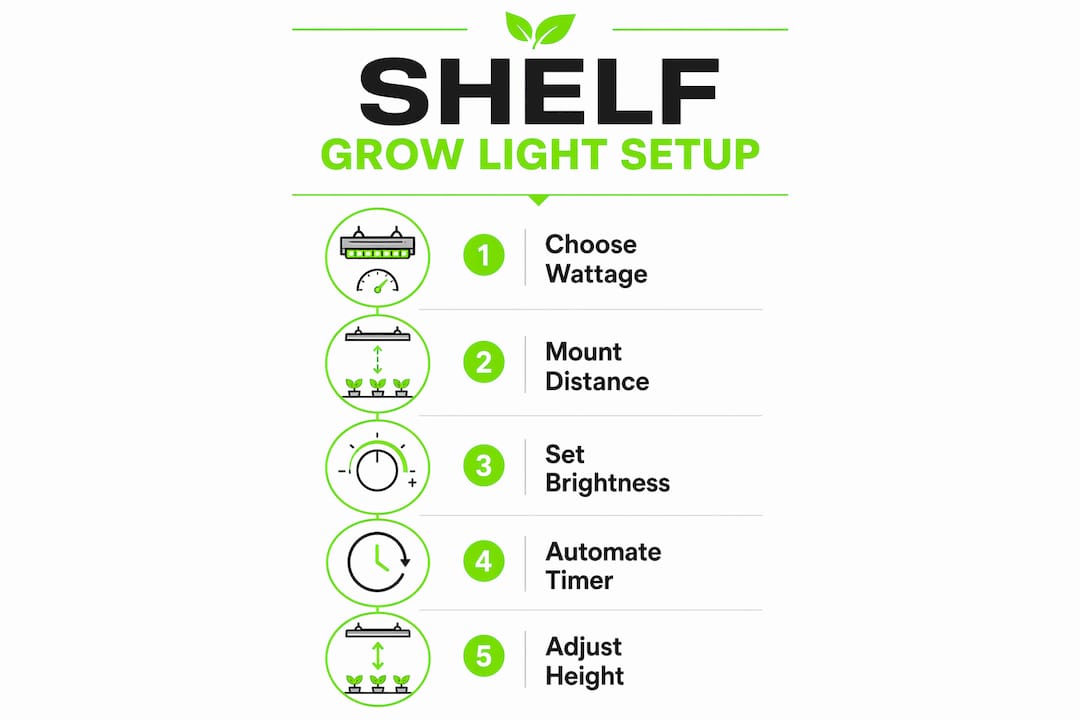
A complete shelf grow light installation requires four components: the LED fixture, a mounting system, a timer or smart controller, and a power strip with surge protection. Wire rack shelving with adjustable tiers works best because you can reposition both shelves and lights as plants grow.
Follow these steps for a clean, functional setup:
Pro Tip: Stagger the on-times for different shelf tiers by 30 minutes if they share a single circuit. This prevents a simultaneous power draw spike that can trip breakers in older apartment wiring.
The most common installation errors fall into three categories:
| Error | Consequence | Fix |
|---|---|---|
| Light mounted too high | Leggy, stretched plants | Lower fixture to correct distance per plant type |
| Inconsistent timer schedule | Slow or stalled growth | Lock in a fixed daily cycle and do not change it |
| Under-wattage fixture | Decorative light, no real growth | Verify actual draw meets 30–40 watts per square foot |
| No dimmer control | Seedling burn or stress | Use dimmable fixtures and start at 20–30% |
Micro grow light kits designed for shelf setups often include pre-cut light bars, mounting clips, and daisy-chain cables that let you connect multiple tiers to one timer. This modular approach is the most practical solution for urban gardeners who want to expand from one shelf to three without rewiring anything.
Plant symptoms are the most reliable diagnostic tool for lighting issues. Leggy stems that stretch toward the light signal insufficient intensity or a fixture mounted too far from the canopy. Yellowing or bleached leaf tips point to the opposite problem: too much intensity at too close a range.
Common problems and their fixes:
Urban gardening expert Mike recommends grow systems with built-in modes and expansion kits to reduce beginner failures tied to inconsistent photoperiods. Modular systems let you add a tier without reconfiguring the entire setup. That scalability matters when you move from growing three herb pots to running a full four-tier vertical garden. LED efficiency for home grows is a real factor here: lower heat and lower electricity draw per photon mean you can run more tiers without a significant jump in your utility bill.
The most effective shelf grow light setup combines 30–40 watts per square foot, correct mounting height by plant type, full spectrum LEDs, and a locked daily timer schedule that never varies.
| Point | Details |
|---|---|
| Hit the wattage target | Deliver 30–40 watts per square foot; anything less produces decorative light, not real growth. |
| Mount at the right height | Position lights 6–8 inches above herbs and 8–10 inches above leafy greens to avoid burn and stretching. |
| Use full spectrum LEDs | Full spectrum output covers both vegetative and flowering phases without fixture swaps. |
| Automate your photoperiod | A fixed daily timer schedule outperforms manual switching for consistent plant growth. |
| Troubleshoot by symptoms | Leggy plants signal low intensity or excessive height; bleached tips signal the opposite. |
Most beginners spend too much time chasing the perfect spectrum and not enough time solving the distance problem. I have seen beautifully specced LED fixtures produce weak, stretched basil simply because the grower mounted the bar at shelf height instead of canopy height. The light looked impressive. The plants told a different story.
The second mistake I see constantly is treating the timer as optional. Growers who manually switch lights on and off introduce variability that plants register as stress. A $12 mechanical outlet timer eliminates that variable entirely. Spend your attention on height and wattage, not on spectrum ratios or color temperature debates.
Vertical spacing on tiered shelves is the single most underrated skill in compact indoor gardening. Getting it right means every tier performs independently at full potential. Getting it wrong means your top tier burns while your bottom tier starves.
My honest recommendation: start with one tier, get the wattage and height dialed in, then expand. Modular systems that daisy-chain across tiers make that expansion straightforward. Resist the urge to fill all four shelves on day one. Plants grown under correctly calibrated light on one tier will outperform plants spread across four poorly configured ones.
— Scott
Urban gardeners who want proven wattage, dimmable control, and modular expansion without the guesswork of piecing together mismatched components have a direct path forward with Ledgrowlightsdepot.

The NextLight 150h LED Grow Light delivers the intensity and spectrum coverage that shelf gardens demand, with output calibrated for close-canopy mounting. Ledgrowlightsdepot carries a full range of LED grow lights built for compact indoor setups, from single-tier herb shelves to multi-tier vertical gardens. Every product is backed by a 4.8 out of 5 rating from more than 5,800 verified customers. If you are ready to move from decorative lighting to real plant production, the right fixture is already in the catalog.
Experts recommend 30–40 watts per square foot of growing area. A standard 2-foot by 4-foot shelf tier requires 240–320 watts of actual LED draw.
Mount lights 6–8 inches above high-light herbs and 8–10 inches above leafy greens. Closer placement increases intensity but risks burn on sensitive foliage.
Most leafy greens thrive on 12-hour photoperiods. Herbs pushing maximum growth benefit from 16-hour cycles. Use an automated timer to keep the schedule consistent every day.
Full spectrum LEDs cover the photosynthetically active radiation range plants need, but no artificial light yet matches direct natural sunlight for long-term fruiting crops. They are highly effective for herbs, greens, and seedlings.
Leggy growth signals that light intensity drops too sharply before reaching the canopy. Lower the fixture by 2 inches and increase brightness. The light may be on, but it is not delivering enough photons at leaf level.
0 of 3 items selected


Leave a comment