
Free Shipping in the USA on nearly all items!
Limited phone hours during the Holidays! Call us: 888-611-9305
Free Shipping in the USA on nearly ALL items! Limited phone hours during the Holidays!

Most gardeners assume seeds need darkness to sprout. Bury them, water them, wait. That assumption works sometimes, but it misses the real story. The role of light in seed germination is far more nuanced than a simple on/off switch. Some seeds won’t germinate without light exposure. Others are actively suppressed by it. And for many, the timing and spectrum of light matter just as much as whether light is present at all. Understanding these distinctions, which scientists group under the term photoblastic responses, can be the difference between a tray full of healthy seedlings and one full of disappointment.
| Point | Details |
|---|---|
| Seeds respond differently to light | Seeds are classified as positive, negative, or neutral photoblastic based on how light affects their germination. |
| Molecular signals drive germination | Light activates phytochrome receptors that degrade germination repressors, triggering sprout initiation at the gene level. |
| Sowing depth changes everything | Deep sowing delays light exposure and disrupts the mechanical signals seedlings need, increasing failure risk. |
| Spectrum matters for seedlings | Red and blue LED wavelengths directly influence seedling development after germination, not just growth rate. |
| Species-specific rules apply | There is no universal light recipe. Match your light strategy to the specific plant and its natural habitat. |
Light does not simply warm a seed or signal daytime. It changes gene expression. When light hits a seed, specialized proteins called photoreceptors detect it and set off a molecular chain reaction that either allows or blocks germination.
The two main players here are phytochrome A (phyA) and phytochrome B (phyB). These receptors respond to different light conditions. PhyB primarily handles red and far-red light responses, which are the wavelengths most relevant to everyday gardening. PhyA handles very low light and high-irradiance responses. Shifts in red versus far-red light alter both the timing and the classification of a seed’s germination behavior.
Here is where it gets genuinely interesting. Inside a dormant seed, a protein called PIF1 acts as a brake. It suppresses germination by blocking the genes that would otherwise push the seed to sprout. When phyB detects red light, it activates an enzyme called UPL3, which physically tags PIF1 for destruction. Loss of UPL3 function delays germination under light because PIF1 stays intact and keeps the brake on. Remove the brake at the right moment, and germination proceeds rapidly.
This molecular cascade also interacts with plant hormones. Abscisic acid (ABA) promotes dormancy, while gibberellin (GA) promotes germination. Light exposure through phytochrome signaling tips the hormonal balance toward GA, which works alongside PIF1 degradation to release the seed from dormancy.
Pro Tip: If you are unsure whether a seed is positive or negative photoblastic, check the seed packet for sowing depth. Seeds that need light are typically sown at the surface or barely covered. Seeds that prefer dark are sown at a depth of 2 to 3 times their diameter.
One of the most practical insights from recent research is that light requirements are highly species-specific, shaped by the natural environment a plant evolved in. There is no universal rule that applies across your entire garden.
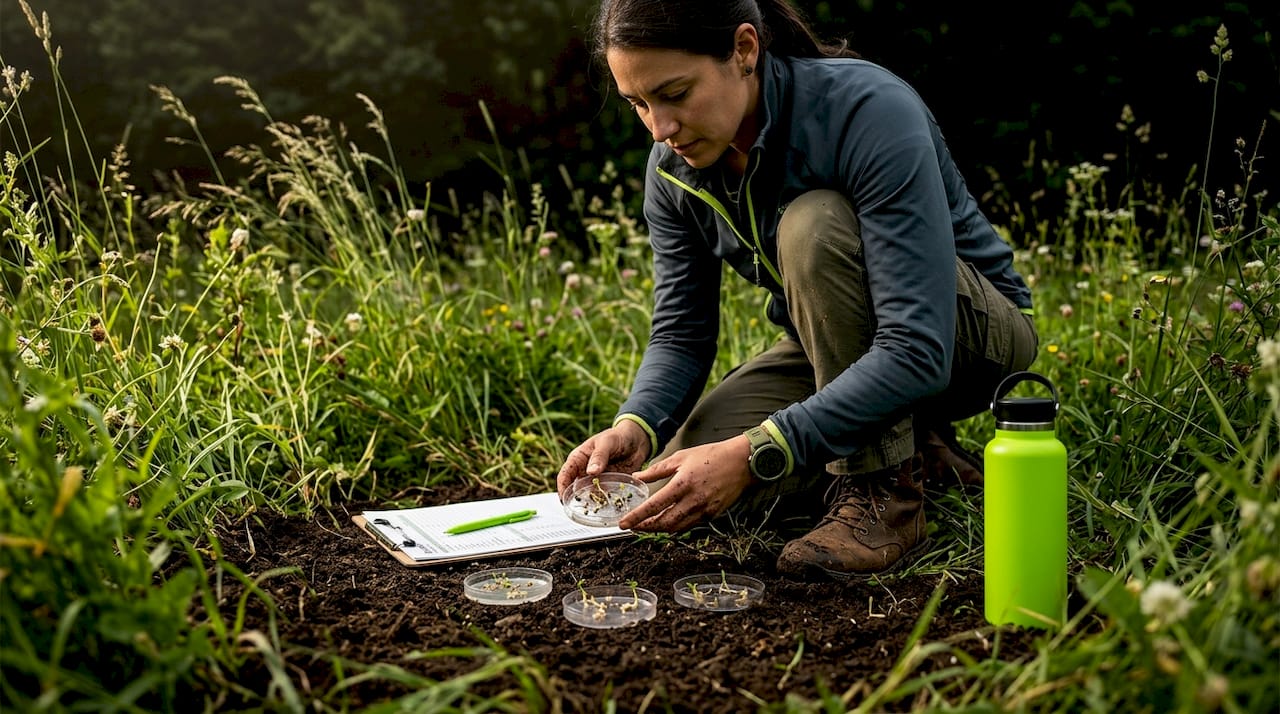
A study on 15 wet grassland species from Brazil’s Cerrado region found that most species needed light to germinate, and that alternating temperatures significantly boosted germination rates in many of them. The ecological logic makes sense: seeds that evolved in open, sunny grasslands developed a positive photoblastic response because light signals that the soil surface is clear and conditions are favorable for growth.
Compare that to forest-floor species, which evolved under dense canopy shade. Many of these developed neutral or negative photoblastic responses because light at the forest floor is filtered, variable, and not a reliable signal of safe germination conditions.
Here is a practical comparison to help you think through your own planting decisions:
| Seed type | Light preference | Sowing method | Example species |
|---|---|---|---|
| Positive photoblastic | Requires light | Surface sow, press lightly | Lettuce, snapdragon, petunia |
| Negative photoblastic | Prefers darkness | Cover 2x seed diameter | Onion, pumpkin, calendula |
| Neutral photoblastic | Light-indifferent | Either method works | Tomato, pepper, basil |
| Temperature-sensitive | Light plus alternating temps | Surface sow, fluctuate temps | Many native grasses, Cerrado species |
Flooding also plays a role for wetland species. The same Cerrado study showed that flooding effects on germination varied widely between species, reinforcing that habitat context shapes light sensitivity in ways that are not always predictable. When you are working with native plants or unusual species, look up their natural habitat before deciding on sowing depth or light exposure.
Germination does not end when the seed cracks open. The transition from seed to established seedling is a separate developmental challenge, and light plays a role here too. One that most gardeners underestimate.
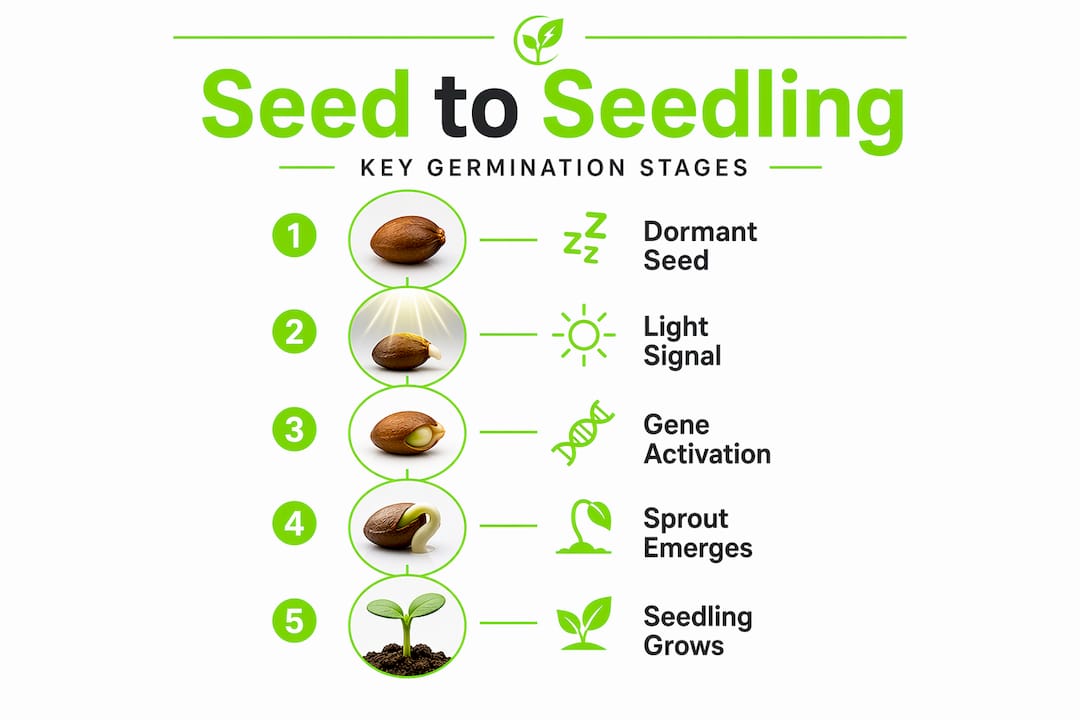
As a seedling pushes upward through soil, it experiences two changing signals simultaneously. Light exposure increases as it gets closer to the surface. Mechanical resistance from the soil decreases as it breaks through. Research shows that these two signals must be coordinated for optimal seedling development. The plant uses both cues together to calibrate its growth strategy.
When you sow too deep, you create a mismatch. The seedling spends extra energy fighting through more soil, which delays the point at which it receives meaningful light. By the time it reaches the surface, its developmental clock is out of sync with the light signal it finally receives. Deep sowing disrupts this coordination and increases the risk of weak or failed establishment, even for seeds that are not strictly light-dependent for germination.
Pro Tip: For most vegetable and flower seedlings started indoors, position your grow light 4 to 6 inches above the tray immediately after emergence. Waiting even a day or two too long can trigger etiolation that is difficult to reverse.
Now that you understand the biology, here is how to put it to work. Whether you are starting seeds on a windowsill or running a dedicated indoor setup, the decisions you make about light directly shape what your seedlings become.
Step-by-step light management for indoor seed starting:
| Growth stage | Recommended PAR (µmol/m²/s) | Light duration | Spectrum |
|---|---|---|---|
| Pre-emergence (positive photoblastic) | 50 to 100 | 12 to 14 hours | Full spectrum white |
| Early seedling (first true leaves) | 100 to 200 | 14 to 16 hours | Full spectrum or red/blue |
| Established seedling | 200 to 400 | 16 to 18 hours | Full spectrum |
The most common mistake gardeners make is waiting too long to introduce light after emergence, then compensating by cranking up intensity. That approach shocks seedlings rather than supporting them. Gradual, consistent exposure from the moment of emergence is what produces stocky, healthy starts.
I have watched gardeners obsess over soil mix and watering schedules while completely ignoring the timing of their light exposure. That is backwards. In my experience, the single biggest factor in seedling quality is not what light you use. It is when you introduce it.
The molecular research on PIF1 degradation makes this concrete. The timing of the light signal is critical because the phyB→UPL3→PIF1 cascade only works efficiently during specific developmental windows. Flooding a seed with light after it has already struggled through darkness for too long does not simply reset the clock. The plant has already made developmental decisions based on the signals it received, or did not receive.
What I find most useful from this research is the reminder that light is information, not just energy. A seed interprets light quality, duration, and timing the way a computer reads code. Getting the spectrum wrong or the timing off does not just slow things down. It sends the wrong instructions entirely.
My practical advice: stop treating grow lights as a substitute for sunlight and start treating them as a precision tool. Match the spectrum to the growth stage. Start the light schedule the moment emergence begins. And please, do not sow positive photoblastic seeds at depth and then wonder why germination is patchy. The seed-to-seedling coordination your plants need cannot be faked with more water or warmer soil.
— Scott
Getting the light strategy right is only half the equation. The other half is having equipment that delivers the right spectrum, intensity, and coverage without guesswork.

Ledgrowlightsdepot carries a full range of LED grow lights built for exactly this kind of precision growing. For small seed-starting setups, the HLG 65 V2 4000K delivers full-spectrum white light that closely mimics natural daylight, which is ideal for the early seedling stage. For larger trays or growing rooms, the Mars Hydro TSL 2000 provides broad, even coverage with PAR values that support seedlings through to vegetative growth. Browse the complete selection of LED grow lights at Ledgrowlightsdepot to find the right fit for your setup. Not sure where to start? A Ledgrowlightsdepot gift card is a flexible option if you want to explore the full catalog before committing.
Yes, many seeds germinate without light. Negative photoblastic seeds like onions and pumpkins actually prefer darkness, while neutral photoblastic seeds germinate equally well in either condition.
Full-spectrum white light or a combination of red (660nm) and blue (450nm) LEDs works best for seedlings. Blue promotes compact leaf growth and red supports stem and photosynthetic development.
Consistent light cycles signal stability to seedlings and regulate hormonal balances that influence growth rate and structure. Most seedlings do well with 14 to 16 hours of light per day.
Stretching, called etiolation, happens when seedlings receive too little light or light from too far away. Move your grow light closer or increase intensity to correct it early, before stems weaken permanently.
Absolutely. Seeds sown too deep receive delayed light exposure, which disrupts the coordinated transition from germination to seedling establishment and significantly increases the risk of weak or failed emergence.
0 of 3 items selected


Leave a comment