
Free Shipping in the USA on nearly all items!
Limited phone hours during the Holidays! Call us: 888-611-9305
Free Shipping in the USA on nearly ALL items! Limited phone hours during the Holidays!

Types of LED grow light spectrums are the specific wavelength combinations these lights emit to drive different phases of plant growth, from seedling to harvest. The main spectrum categories are blue (400–500 nm), red (600–700 nm), far-red (700–750 nm), green (490–560 nm), and UV (100–400 nm). Each wavelength range triggers distinct biological responses in plants, and knowing which to use at each growth stage is the single most direct way to increase indoor yields. Modern LED fixtures from brands like HLG, Mars Hydro, Viparspectra, and Spider Farmer now let you tune these ratios rather than accept the fixed output of legacy HPS or metal halide lights.
Understanding the full LED grow light spectrum guide starts with recognizing that plants do not respond equally to all wavelengths. Chlorophyll A absorbs most strongly near 437 nm and 680 nm, while chlorophyll B peaks near 450 nm and 640 nm. Photoreceptors like phytochrome and cryptochrome respond to red and blue light respectively, controlling flowering time, stem elongation, and stomatal opening. Getting the wavelength mix right means your plants spend energy on growth and reproduction rather than compensating for poor light quality.
Spectrum types for grow lighting are broadly divided into blue, red, and far-red, with green and UV as advanced additions. Each serves a distinct biological function, and the best LED light spectrum for your crop depends on the growth stage and the plant species you are cultivating.
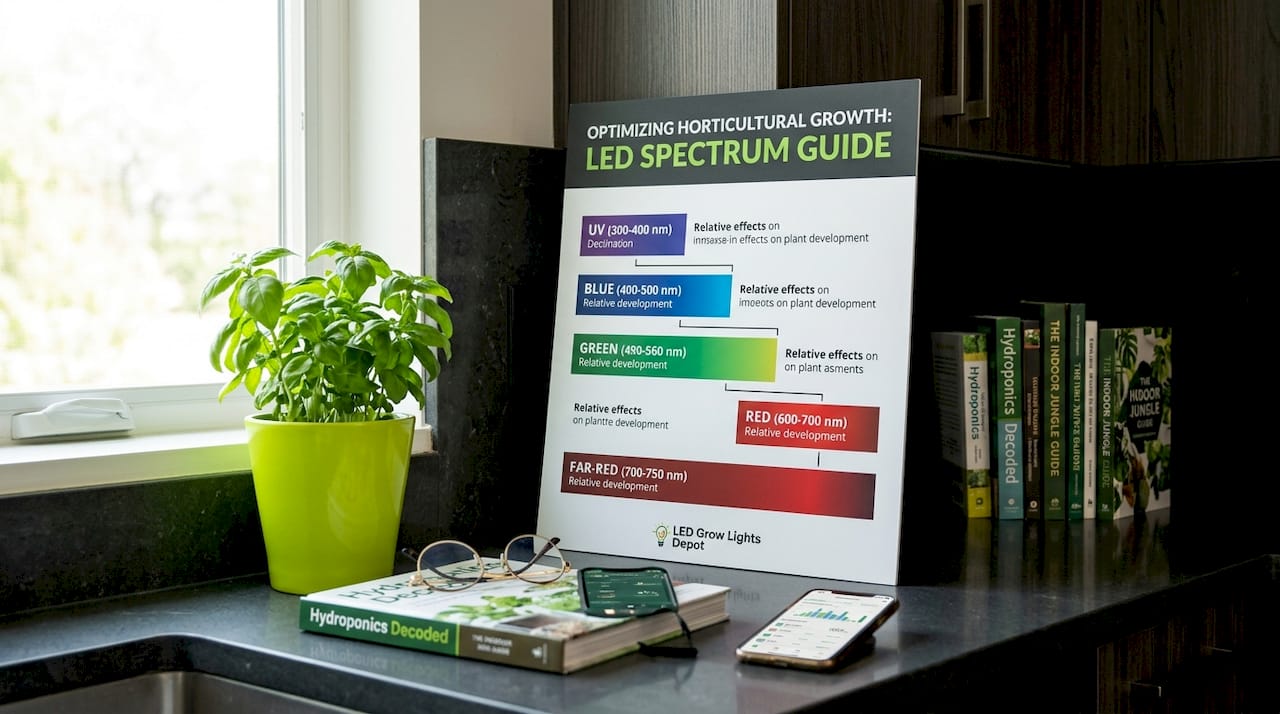
Blue light in the 400–500 nm range is the primary driver of vegetative structure. It activates cryptochrome and phototropin receptors, which suppress internode elongation and produce shorter, stockier plants with thicker leaves. Growers who increase blue during the vegetative stage consistently see denser canopies and stronger stems before the flip to flowering.
Key effects of blue spectrum LEDs:
Fixtures like the Spider Farmer SF1000 emit a white-dominant spectrum with strong blue content, making them well suited for vegetative stages in small grow tents.
Pro Tip: Raise your blue ratio to roughly 30–40% of total output during weeks 2–5 of vegetative growth, then dial it back as you approach the pre-flower transition. This single adjustment can noticeably reduce stretch without slowing overall growth rate.
Red light in the 600–700 nm range is the most photosynthetically active wavelength for most crops. It drives phytochrome conversion from Pr to Pfr, the molecular switch that signals flowering in photoperiod-sensitive plants. Crop-specific dominant wavelengths for flowering are concentrated between 640 nm and 720 nm, with dual peaks at approximately 640 nm and 660 nm delivering the broadest chlorophyll activation.
The dual-red peak design is a meaningful upgrade over single-peak red LEDs. A 640 nm peak targets chlorophyll B absorption while 660 nm hits the chlorophyll A peak directly. Together, they drive faster biomass accumulation and more uniform bud development across the canopy.
Key benefits of dual-red peak spectrum design:
Advanced red spectrum designs, sometimes called “Dual Red Terp Boost” configurations, add a secondary red peak specifically to increase terpene and cannabinoid expression in cannabis. This goes beyond basic flowering stimulation and targets biochemical output quality.
LED spectrum tuning allows growers to increase red ratios during the flowering stage without replacing the fixture, a capability that HPS and metal halide lights simply cannot offer. For commercial tomato and pepper growers, shifting to a higher red ratio at week 3 of flowering can measurably increase fruit weight per plant.
Far-red light sits between 700 nm and 750 nm, just outside the traditional photosynthetically active radiation (PAR) window, but its effects on plant growth are significant. It stimulates photosystem I directly, which accelerates the overall photosynthetic electron transport chain when combined with red and blue light. This is sometimes called the Emerson Enhancement Effect, and it means that adding far-red to a red-dominant spectrum can increase net photosynthesis beyond what either wavelength achieves alone.
Far-red also controls plant morphology through the phytochrome photostationary state. High far-red to red ratios signal shade conditions, causing plants to elongate and redirect energy toward canopy expansion. Growers use brief far-red pulses at the end of the photoperiod to accelerate flowering in some cultivars, reducing days to harvest.
Pro Tip: Use far-red in short end-of-day pulses of 10–15 minutes rather than throughout the entire photoperiod. This mimics natural sunset signals and can accelerate flowering without triggering unwanted stretch during the main light cycle.
One critical caveat for commercial growers measuring photosynthetic performance: far-red overlaps with chlorophyll fluorescence detection in PAM fluorometers between 680 nm and 760 nm. This causes artificially elevated photosystem II efficiency (ΦPSII) readings, particularly at PPFD levels above 800 µmol m⁻² s⁻¹. If you are using PAM-based measurements to optimize your grow, run controls without far-red to confirm your readings are not inflated by spectral overlap artifacts.
Far-red enhances photosystem I stimulation and overall photosynthetic performance, but measurement accuracy requires careful protocol design when far-red LEDs are active.
Green light in the 490–560 nm range was historically dismissed as ineffective because plants reflect much of it, giving leaves their green color. More recent research shows that green wavelengths penetrate deeper into the canopy than red or blue, reaching lower leaves that would otherwise receive only reflected light. This makes green a meaningful contributor to whole-plant photosynthesis in dense canopies.
UV light below 400 nm, particularly UVA (315–400 nm) and UVB (280–315 nm), triggers stress responses that increase secondary metabolite production. For cannabis growers, UV exposure during the final weeks of flowering increases trichome density and cannabinoid concentration. For herb growers, UV raises essential oil content in basil, rosemary, and mint.
Benefits of green and UV in full-spectrum LED designs:
Biology-driven LED designs like the Nova Sun Series incorporate emerald/teal green, dual red peaks, far-red near 730 nm, and optional UVA/UVB to target multiple photoreceptors simultaneously. This approach moves well beyond the simple red and blue LED spectrum model that dominated early LED grow light design.
Full spectrum grow lights combine blue, green, red, far-red, and sometimes UV into a single fixture output that approximates natural sunlight. They are the most practical choice for growers who run mixed crops, cannot adjust their light settings between stages, or are starting out and want one fixture that performs reliably across the entire growth cycle.
The Viparspectra Pro Series P4000 is a strong example of a full-spectrum fixture designed for both vegetative and flowering stages without manual spectrum adjustment. For growers who want more control, the HLG 100 4000K delivers a white-dominant full spectrum with tunable red and blue components.
Full spectrum LEDs are not always the highest-performing option for single-crop commercial operations. A tomato grower running 10,000 square feet has more to gain from a stage-tuned spectrum recipe than from a fixed full-spectrum output. But for home growers running lettuce, basil, pepper, and herbs in the same tent, full spectrum is the most forgiving and effective choice.
| Spectrum type | Wavelengths included | Best for | Key advantage |
|---|---|---|---|
| Blue only | 400–500 nm | Seedlings, vegetative stage | Compact growth, strong stems |
| Red and blue | 400–500 nm + 600–700 nm | Flowering, fruiting crops | High photosynthetic efficiency |
| Dual red peak | ~640 nm + ~660 nm | Cannabis, tomato, strawberry | Broader chlorophyll activation |
| Far-red enhanced | 700–750 nm added | Flowering acceleration, shade crops | Emerson Enhancement Effect |
| Full spectrum | 400–750 nm + optional UV | Mixed crops, all stages | Versatility, natural light simulation |
| UV-enhanced | Adds 315–400 nm | Cannabis, herbs, specialty crops | Terpene and secondary metabolite boost |
Spectrum tuning capability is the defining advantage of LED grow lights over legacy HPS and metal halide systems, which emit fixed spectra regardless of crop stage.
For crop-specific starting points: lettuce and spinach respond well to a blue-dominant spectrum with moderate red. Basil and herbs benefit from added UV in the final two weeks. Tomato, pepper, and strawberry perform best under dual-red peak spectrums during flowering and fruiting. Cannabis growers running full cycles get the most from a tunable fixture that shifts from blue-heavy vegetative to red-dominant flowering with far-red and UV additions at the end.
Pro Tip: If you are a commercial grower managing more than 500 square feet, invest in a multi-channel spectrum-tuning fixture rather than a fixed full-spectrum model. The ability to program stage-specific recipes pays for the cost difference within two to three crop cycles through improved yield and quality.
Choosing the right LED grow light spectrum type is the most direct lever growers have for improving yield, quality, and energy efficiency at every crop stage.
| Point | Details |
|---|---|
| Blue drives vegetative structure | Use 400–500 nm to produce compact, thick-leaved plants with strong stems before flowering. |
| Dual red peaks outperform single red | Fixtures with ~640 nm and ~660 nm peaks activate both chlorophyll A and B for faster biomass gain. |
| Far-red requires careful use | Short end-of-day far-red pulses accelerate flowering; avoid all-day far-red to prevent unwanted stretch. |
| Full spectrum suits mixed grows | Home growers with multiple crop types get the best results from a single full-spectrum fixture. |
| Spectrum tuning pays off commercially | Multi-channel tunable LEDs deliver stage-specific recipes that fixed-spectrum lights cannot match. |
I have talked with hundreds of growers who upgraded from HPS to LED and then stopped there, assuming the switch itself was the optimization. It is not. The switch removes heat and cuts the power bill. The real yield gains come from what you do with the spectrum control that LEDs give you.
The most common mistake I see is running a full-spectrum fixture at the same output from seed to harvest. Full spectrum is a great starting point, but it is not a finished recipe. Tomato growers who shift to a higher red ratio at week 3 of flower, or cannabis growers who add a 10-minute far-red pulse at lights-out, are getting measurably better results from the same fixture. The hardware is already capable. Most growers just never use it.
My honest recommendation: start with a quality full-spectrum fixture if you are new or running mixed crops. The HLG 65 V2 is a reliable entry point for small spaces. Once you understand how your specific crops respond to light, move toward a tunable multi-channel fixture. The science on biology-driven spectrum recipes targeting multiple photoreceptors is solid, and the commercial results back it up.
One thing I would caution against: chasing UV and far-red additions before you have your core red and blue dialed in. Those are finishing tools, not foundations. Get your baseline spectrum right first, then layer in the advanced wavelengths.
— Scott
Ledgrowlightsdepot carries a broad selection of LED grow lights covering every spectrum type discussed in this guide, from blue-dominant vegetative fixtures to full-spectrum models and advanced tunable systems for commercial operations. Whether you are growing lettuce in a 2x2 tent or running a 1,000-square-foot commercial pepper operation, the right spectrum fixture is in the catalog. Ledgrowlightsdepot holds a 4.8 out of 5 rating from more than 5,800 verified growers, and the team can help you match a fixture to your specific crop and stage requirements. Browse the full range of LED grow lights to find a spectrum solution built for your growing goals.
The main types are blue (400–500 nm), red (600–700 nm), far-red (700–750 nm), green (490–560 nm), and UV (100–400 nm). Full spectrum grow lights combine all of these into a single fixture output suitable for all growth stages.
Blue light in the 400–500 nm range is the best LED light spectrum for vegetative growth. It suppresses stem elongation, thickens leaves, and produces compact, sturdy plants ready for flowering.
Far-red light enhances photosynthesis through the Emerson Enhancement Effect when combined with red light, and short end-of-day pulses can accelerate flowering. However, it causes measurement artifacts in PAM fluorometers, so growers using photosynthesis meters should run controls to avoid inflated readings.
Full spectrum grow lights cover all growth stages in a single fixture, making them the practical choice for home growers and mixed-crop operations. Commercial growers with single-crop operations typically get better results from tunable multi-channel fixtures that allow stage-specific spectrum recipes.
A dual red peak spectrum includes LED diodes emitting at approximately 640 nm and 660 nm, targeting both chlorophyll B and chlorophyll A absorption peaks simultaneously. This delivers broader photosynthetic activation than a single-peak red LED, resulting in faster biomass accumulation and more uniform flowering across the canopy.
0 of 3 items selected


Leave a comment