
Free Shipping in the USA on nearly all items!
Limited phone hours during the Holidays! Call us: 888-611-9305
Free Shipping in the USA on nearly ALL items! Limited phone hours during the Holidays!

LED grow lights save electricity because they convert a far greater share of electrical energy into photosynthetically useful light than any older technology, while generating minimal waste heat that would otherwise force your cooling system to work harder. This dual advantage, superior light conversion plus reduced thermal load, is why LED horticulture lighting has become the standard for energy-conscious home and urban growers. Modern fixtures from brands like Horticulture Lighting Group and ThinkGrow achieve photon efficacies around 3.0 to 3.4 µmol/J, nearly double the output of legacy HPS systems. Understanding why LED grow lights save electricity means understanding both of those mechanisms together.
The technical term for measuring how efficiently a grow light produces plant-usable light is photosynthetic photon efficacy, or PPE. PPE is expressed in micromoles of photons per joule of electricity (µmol/J), and it is the single most honest metric for comparing grow lights. Wattage tells you how much power a fixture draws. PPE tells you how much of that power actually reaches your plants as photosynthetically active radiation (PAR).
Top-tier 2026 LED fixtures achieve around 3.0 to 3.1 µmol/J, compared to roughly 1.7 µmol/J for a 1000W HPS lamp. That gap means an LED fixture delivers nearly double the photons per watt consumed. For a home grower running lights 16 hours a day, that difference compounds into a meaningful monthly electricity reduction.
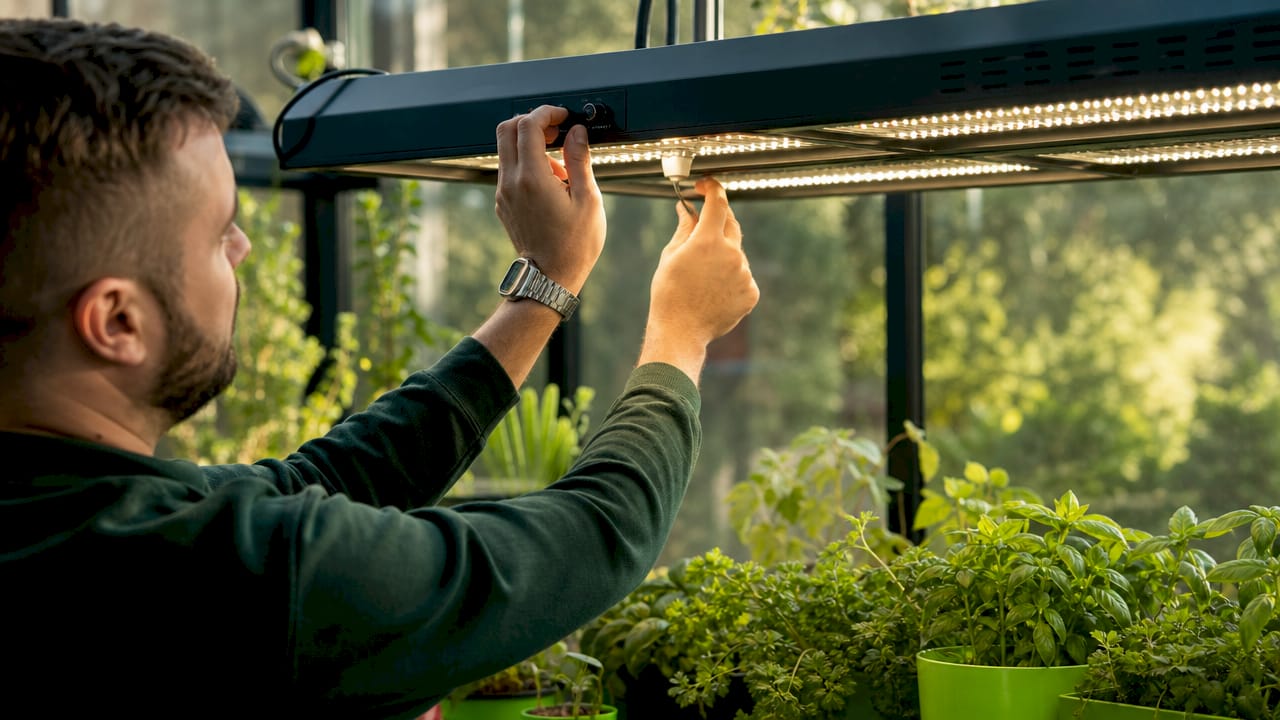
Modern LED grow lights convert 50 to 70% more electricity into usable plant light than older technologies. That efficiency gain comes from the semiconductor design of LEDs, which emit light in targeted wavelengths rather than broadcasting a broad spectrum that includes infrared and ultraviolet energy your plants cannot use. HPS and metal halide lamps waste a large portion of their draw on wavelengths outside the PAR range of 400 to 700 nanometers.
The Frontiers 2026 vertical farming study confirmed that LED fixtures at low PPFD maintained high lamp efficacy around 3.0 to 3.4 µmol/J even under continuous lighting conditions. That finding matters because it shows the efficiency advantage holds across different usage patterns, not just under ideal lab conditions.
Pro Tip: When shopping for energy-efficient grow lights, always ask for the PPE rating in µmol/J rather than relying on wattage comparisons. A 200W LED fixture with a PPE of 3.0 µmol/J delivers more usable light to your plants than a 400W HPS at 1.7 µmol/J, and at half the electricity cost.
Waste heat is the hidden electricity cost that most growers underestimate. Every watt an HPS or HID lamp draws that does not become PAR light becomes heat inside your grow space. That heat must be removed, and removing it requires fans, air conditioners, or exhaust systems that draw additional electricity on top of your lighting bill.
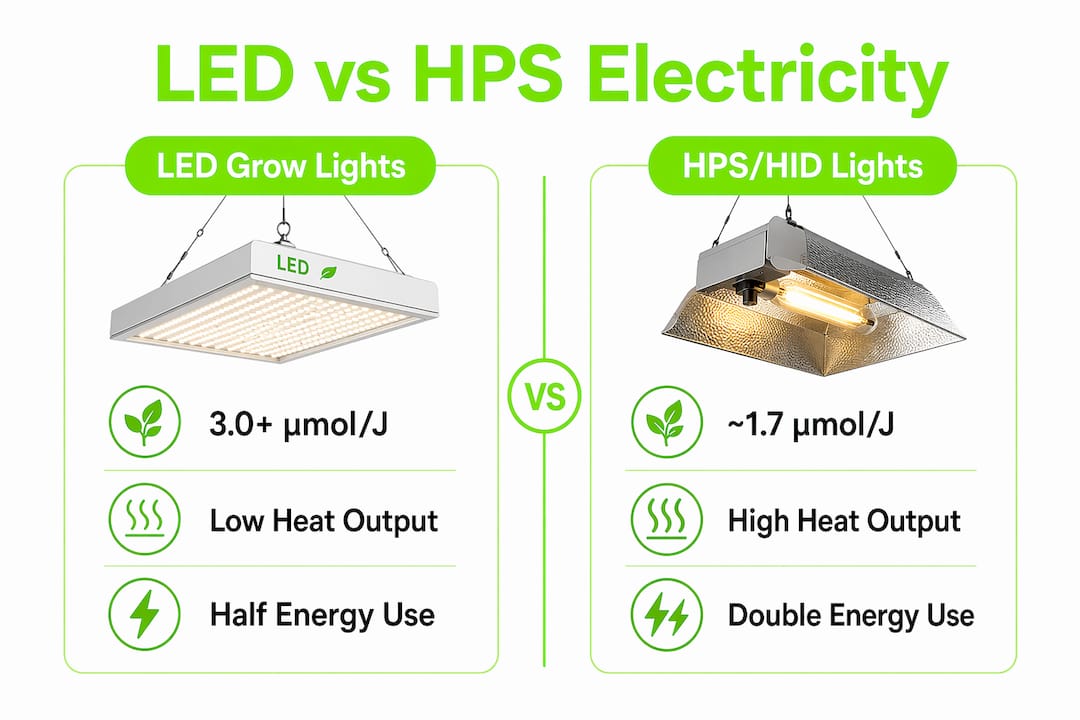
University of Georgia Extension research confirms that HID systems generate high heat output, while LEDs produce very little radiant heat. The practical result for home growers is that switching to LEDs often allows you to run smaller fans, reduce air conditioning runtime, or eliminate a dedicated cooling unit entirely. Those indirect savings frequently match or exceed the direct savings from the light conversion efficiency alone.
Consider what this means for a typical 4x4 grow tent setup. A 600W HPS lamp running 18 hours a day generates enough heat to raise tent temperature by 10 to 15 degrees Fahrenheit above ambient. Keeping that space in the optimal 70 to 85°F range for most plants requires active cooling. A comparable LED fixture drawing 300W generates a fraction of that heat load, often allowing passive ventilation to handle temperature control.
“LEDs produce little heat, enabling placement close to seedlings to avoid heat damage and reducing environmental control energy needs.” — University of Georgia Extension
The low thermal output of LEDs also means you can position fixtures closer to your plant canopy without risking heat stress. That proximity improves light uniformity and intensity at the leaf surface, which means your plants receive more usable photons from the same fixture. Ledgrowlightsdepot’s proprietary proximity systems are specifically designed around this principle, allowing growers to maximize under-canopy light distribution without the burn risk that makes close placement impossible with HPS.
Pro Tip: If you are transitioning from HPS to LED in an existing grow space, measure your ambient temperature after switching. Most growers find they can reduce fan speed or cooling unit runtime within the first week, which adds to monthly electricity savings beyond what the wattage reduction alone suggests.
Light scheduling is one of the most underused tools for reducing electricity consumption, and LEDs make it far more practical than older technologies allow. Three metrics define how much light your plants actually receive: PPFD (photosynthetic photon flux density, measured in µmol/m²/s), photoperiod (hours of light per day), and daily light integral or DLI (the total photon dose delivered over 24 hours, measured in mol/m²/day).
Getting the right DLI for your crop is what matters for plant growth. How you deliver that DLI determines your electricity cost. The Frontiers 2026 study demonstrated that continuous low-PPFD lighting improved energy use efficiency and reduced cost per unit of biomass compared to shorter photoperiods at higher intensity, without compromising lettuce growth or quality. The study recorded total energy consumption of 130 kWh per square meter under optimized LED lighting scenarios, a figure that reflects how scheduling choices directly shape your electricity bill.
Here is a practical framework for applying this to your home grow:
The key insight here is that electricity savings depend on fixture efficacy matched to plant needs, not wattage alone. A poorly chosen LED fixture can cost just as much to run as an HPS if it requires extended hours to compensate for insufficient output.
Pro Tip: A $30 smart plug with energy monitoring, such as the Kasa EP25 or Emporia Vue, lets you track your actual kWh consumption per grow cycle. Comparing that number across different photoperiod settings reveals exactly which schedule delivers the best growth per dollar of electricity.
Translating efficacy data into actual dollars is where the benefits of LED grow lights become concrete. A standard 1000W HPS setup running 18 hours a day consumes 18 kWh daily. At the U.S. average electricity rate of roughly $0.16 per kWh, that is about $2.88 per day or $86 per month, just for the light. A comparable LED fixture drawing 500W at 3.0 µmol/J delivers the same or greater photon output at half the wattage, cutting that lighting cost to approximately $43 per month.
Add the cooling savings. If the HPS setup requires a small window AC unit running 8 hours a day at 500W to manage heat, that adds another $19 per month. The LED setup, generating far less heat, may need only a small fan. The combined monthly savings can reach $50 to $60 for a single-light home grow, which means a quality LED fixture often pays for itself within one to two growing seasons.
The long-term picture is equally compelling:
For home growers comparing LED vs. HID options, the electricity math now strongly favors LEDs at every scale from a single herb shelf to a full basement grow room.
| Feature | LED grow lights | HPS/HID grow lights |
|---|---|---|
| Lamp efficacy | 3.0 to 3.4 µmol/J | 1.7 µmol/J |
| Monthly electricity (500W, 18 hrs) | ~$43 | ~$86 (1000W equivalent) |
| Heat output | Low, minimal cooling needed | High, active cooling required |
| Bulb lifespan | 50,000+ hours | 10,000 to 24,000 hours |
| Spectrum degradation over time | Minimal | Significant |
LED grow lights save electricity through two compounding advantages: higher photon efficacy per watt and dramatically lower waste heat that reduces cooling energy demands.
| Point | Details |
|---|---|
| PPE is the right metric | Choose fixtures rated at 3.0 µmol/J or higher, not by wattage alone. |
| Heat reduction doubles savings | Lower thermal output cuts cooling electricity, often matching direct lighting savings. |
| Light scheduling matters | Continuous low-PPFD lighting improves energy use efficiency without sacrificing plant growth. |
| Long lifespan lowers total cost | LED fixtures last 50,000+ hours, eliminating frequent bulb replacement costs. |
| Match fixture to crop needs | Savings only materialize when the fixture delivers the correct PPFD and DLI for your plants. |
The biggest mistake I see home growers make is treating the LED purchase as the finish line. They buy a fixture, swap it in, and assume the savings are automatic. Sometimes they are. But the growers who see the most dramatic reductions in their electricity bills are the ones who treat the switch as the starting point for a smarter approach to light management.
The wattage reduction is real and immediate. What surprises most people is how much the cooling savings add up. I have spoken with growers who cut their monthly electricity bill by more than 40% after switching, and a significant portion of that came from being able to turn off a portable AC unit they had been running constantly with their old HPS setup.
The other thing worth saying plainly: not all LEDs save electricity equally. A cheap fixture with a PPE of 1.8 µmol/J is barely better than an HPS and costs you the same or more to run per photon delivered. The LED grow light spectrum and the verified efficacy rating of the fixture matter more than the brand name or the price tag. I would rather see a grower spend more on a verified 3.0+ µmol/J fixture than save money upfront on something that underperforms.
Monitor your actual consumption. A smart plug with energy tracking costs less than $30 and tells you exactly what each grow cycle costs. That data lets you adjust photoperiods, dial in DLI targets, and find the schedule that gives you the best harvest per kilowatt-hour. That is where the real optimization happens, and it is available to every home grower willing to pay attention.
— Scott
If you are ready to reduce your electricity costs and grow better plants at the same time, Ledgrowlightsdepot carries a curated selection of fixtures verified for real-world efficacy. Every product in their lineup is chosen with home and urban growers in mind, from compact units for herb shelves to full-power fixtures for serious indoor gardens.
Ledgrowlightsdepot’s team backs every purchase with expert guidance on matching fixture output to your specific crop and grow space. With a 4.8 out of 5 rating from more than 5,800 verified customers, their LED grow lights cover every scale and budget. If you want a proven mid-range option, the NextLight 150h is a strong starting point for home growers making the switch from HPS.
LED grow lights achieve photon efficacy of 3.0 to 3.4 µmol/J compared to roughly 1.7 µmol/J for HPS, meaning they deliver nearly twice the usable plant light per watt consumed. They also generate far less waste heat, which reduces the electricity your cooling system draws.
A 500W LED fixture running 18 hours a day costs roughly half as much to operate as a 1000W HPS delivering equivalent photon output, and the cooling savings add further reductions. Most home growers recover the cost of a quality LED fixture within one to two growing seasons.
PPE stands for photosynthetic photon efficacy, measured in µmol/J, and it tells you how many plant-usable photons a fixture produces per joule of electricity. It is a more accurate measure of energy efficiency than wattage because it reflects actual light output, not just power consumption.
Yes. Research from a 2026 Frontiers vertical farming study showed that continuous low-PPFD lighting improved energy use efficiency compared to shorter photoperiods at higher intensity, delivering the same daily light dose at lower total electricity consumption.
No. Fixture quality varies significantly, and a low-cost LED with a PPE below 2.0 µmol/J offers little advantage over older HPS technology. Always verify the PPE rating before purchasing, and prioritize fixtures rated at 3.0 µmol/J or higher for meaningful electricity savings.
0 of 3 items selected


Leave a comment